AI lab for biodiversity
- 3 March 2026
Conclusion Impact Bos
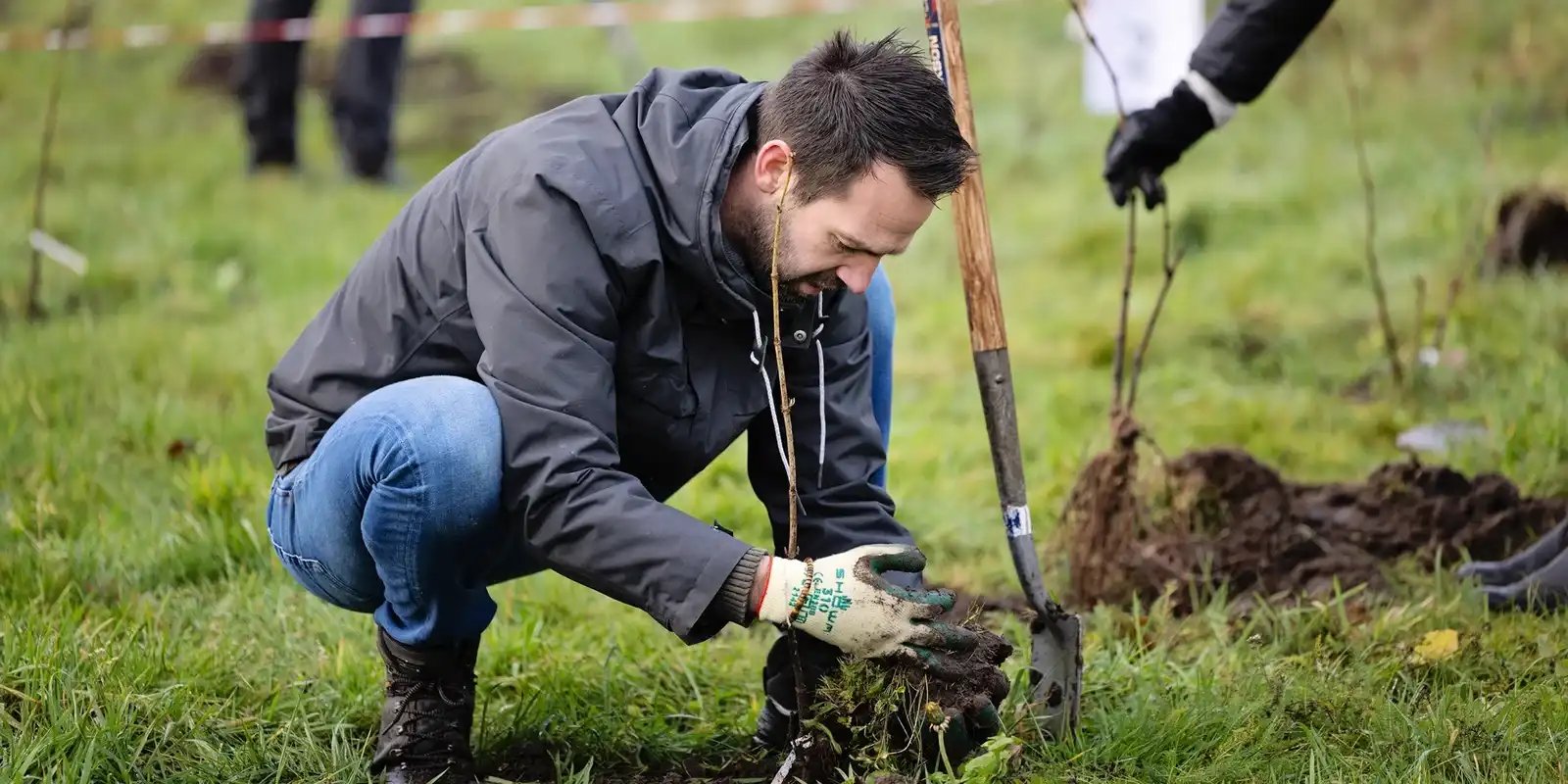
It all started in 2022, when Conclusion joined forces with Trees for All and Brabants Landschap for a long-term collaboration and together launched the Impact Forest. The aim was to increase local biodiversity with a variety of trees, grasses and microhabitats.
29,000 trees were planted on approximately eight hectares of agricultural land. This gradually created an ecologically rich area with 5.5 hectares of forest and 2.5 hectares of herb-rich fields, grassland and ponds.
Biodiversity as a foundation
As biodiversity increased, so did the interest of data and AI specialists in the Impact Forest. This is because the area also harbours a rich source of applicable data.
‘Biodiversity is a much broader concept than many people assume,’ says Raymond van Ek, Director of Business Change & Sustainability at Conclusion Intelligence. ‘It's about more than just different species of plants and animals. Biodiversity is the backbone of our ecosystems. Without bees and butterflies, for example, we would have a major problem with our food supply.’
The men and women of Conclusion, Trees for All and Brabants Landschap often literally walk with their feet in the clay, in and around the Impact Forest. ‘It's wonderful to see how the ecosystem is developing. As we watch and talk, we gain new insights all the time.’
The Impact Forest as a source of data
"We see the Impact Forest as a giant source of data. At Conclusion we know exactly what to do with that, because we have five hundred colleagues who specialise in data and AI. It made us wonder: how can we use our combined knowhow to multiply the ecological impact of the Impact Forest?"
Raymond and his colleagues started by combining a variety of data sources using AI. This allows them to compare the ‘diverse’ Impact Forest with the neighbouring agricultural area, where usually only one crop grows.
Raymond: “We combine data from our fieldwork with historical records dating back to 1950, national databases, satellite images and geographical information”. This creates a 'film' showing how a natural area develops over time. By bringing historical data together with current insights, we get an increasingly sharp picture of how nature and biodiversity work. It helps us recognise trends, intervene where needed and better assess the impact of what we plant."
“Biodiversity is a much broader concept than many people assume.
”
Fact-based management of biodiversity
“We are also discovering which changes in the ecosystem and the environment are related to biodiversity loss. In this way, we are gradually building up knowledge that will help to make nature future-proof. A valuable form of fact-based improvement.”
AI helps to piece together the puzzle: data no longer needs to be manually extracted from archives. Policy documents from thirty years ago are being digitised and made searchable. In this way, AI establishes links between current results and measures that were taken in the past.
‘We are now testing a model in which AI makes suggestions,’ says Raymond. In this project, the black woodpecker is a so-called target species, symbolising a desirable type of habitat. If the black woodpecker is doing well, it is often a sign that the ecosystem is healthy.
‘We ask our AI model a question, such as: what can you do to help the black woodpecker? AI then analyses all the information about its habitat and the measures that have worked. AI then makes a proposal. We then check: does this match what we see in the field?’
Making biodiversity
measurable for businesses
The bigger picture involves more than just counting woodpeckers. Many organisations include biodiversity as a theme in their ESG (Environmental, Social, Governance) objectives. To do so, they need to be able to provide insight into their ecological impact, but that is difficult. Much of the data is fragmented and difficult to access. Our approach makes it concrete.
‘We hope this project will inspire organisations. Biodiversity sounds like something big and complicated, but it doesn't have to be,’ says Raymond. ‘This project shows how you can measure biodiversity relatively easily and how you can contribute to it in concrete terms. We expect to share our first proven insights in the autumn of 2025.’
‘The great thing is: this is not a theoretical exercise,’ says Raymond. ‘We are literally standing with our feet in the field, between the pools and herb-rich grasslands. And in the meantime, we are working with AI on a future in which biodiversity is just as measurable as CO₂.’
“Step by step we’re building knowledge to make nature futureproof. A great example of factbased improvement.
”
About Trees for All
Trees for All has been working since 1999 to restore forests and plant new trees. Together with local partners, including Conclusion, the foundation develops sustainable projects that contribute to healthy ecosystems and good living conditions for both people and nature.
About Brabants Landschap
Brabants Landschap werkt aan het behoud en de ontwikkeling van natuur in Noord‑Brabant. De stichting beschermt waardevolle landschappen, herstelt biodiversiteit en zorgt ervoor dat natuurgebieden behouden blijven en toegankelijk zijn voor wandelaars, fietsers en andere bezoekers.
Biodiversity under pressure
Biodiversity is under pressure worldwide, and the loss is particularly severe in the Netherlands. Yet its importance has barely sunk in for many companies. While our wellbeing and economy strongly depend on healthy ecosystems, biodiversity often remains an abstract concept that’s hard to turn into concrete action.
One major barrier is that organisations often don’t really know what biodiversity includes or how they can influence it. There’s a lack of data, knowledge and a clear sense of what to do. Still, small well‑thought‑out steps can already make a difference. Technology and IT can help. By raising awareness and working together with ecological experts, companies can actively contribute to restoring biodiversity and strengthen their own resilience at the same time.
A joint effort for a sustainable future
In a world that is becoming increasingly sustainable and digital, we embrace our role in accelerating this transition. We drive sustainable solutions and champion sustainable employability. We believe it’s important for our employees to enjoy their work. That’s why we prioritize their health, well-being and personal development.
Questions?
Diane Breure
- Recruiter